The biblical concept of the firstborn is defined by mission and legacy rather than chronological birth order
1/22/2026
Compiled by: TJ
Why the Bible’s ‘Firstborn’ Is Almost Never Born First: A Linguistic Detective Story
Have you ever noticed how obsessed the Book of Genesis seems to be with the status of the firstborn? From the patriarchs down to their children, the narrative revolves around this question: who will carry the blessing and the legacy? Yet, as you read these stories, a strange and undeniable puzzle emerges.
The person who is actually born first almost never receives the status of the firstborn. Abraham’s first son, Ishmael, is passed over for his younger brother, Isaac. Decades later, the blessing meant for the firstborn Esau is famously given to his younger twin, Jacob. What is going on here? Why does the text emphasize a role only to consistently give it to someone other than the person who logically deserves it?
The clues to solving this paradox don’t lie in family drama, but are hidden in plain sight, encoded within the language itself. To crack the case, we must become linguistic detectives.
“Firstborn” Isn’t a Title, It’s a Job Description
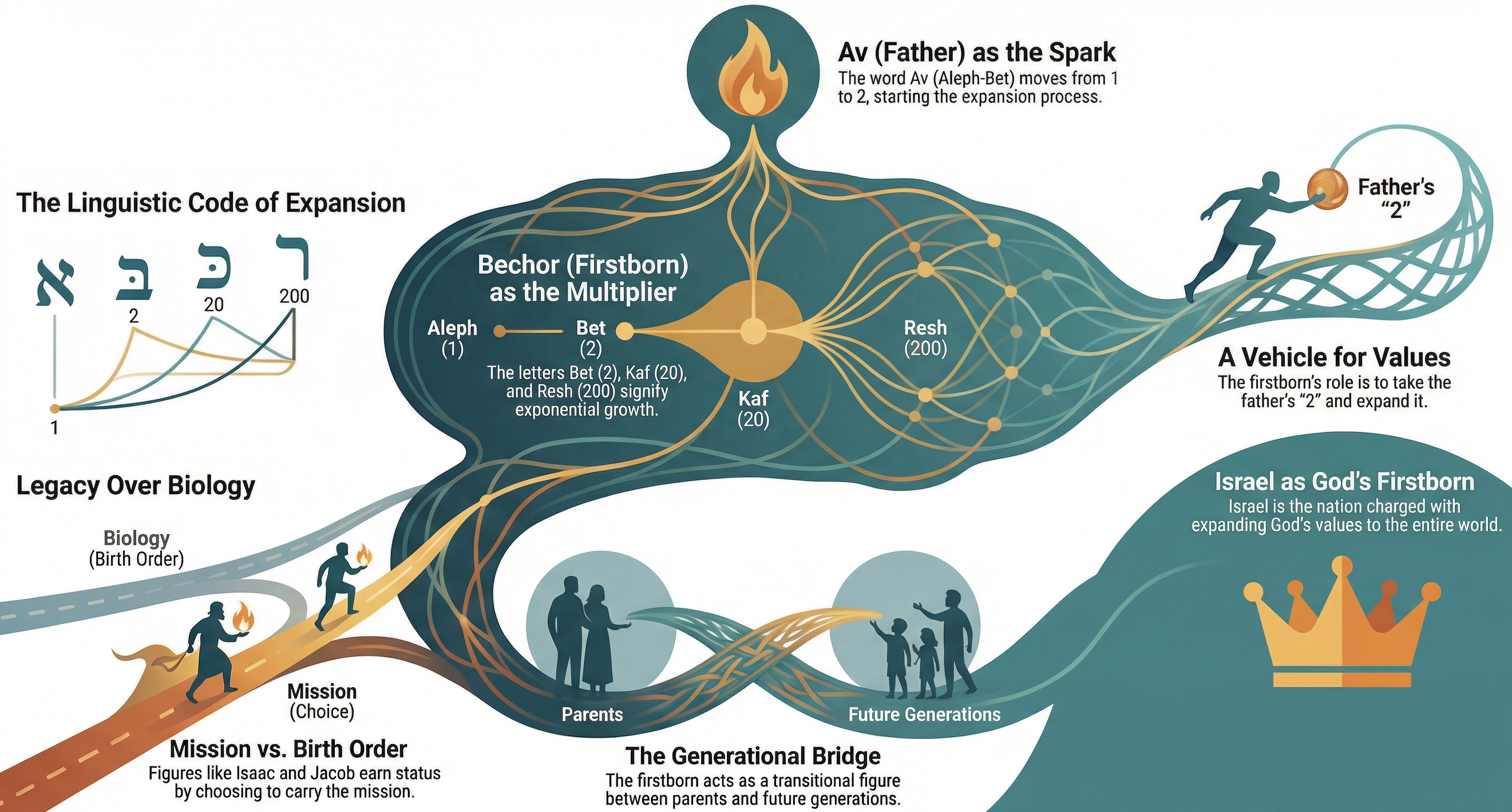
Before we dive into the language, we must first shift our perspective. In the ancient family unit, the firstborn was not just a title of privilege; it was a profound responsibility. The firstborn son was a “transitional figure,” a living generational bridge connecting the parents to the rest of the children.
Because he was closest in age to both generations, the firstborn was in the perfect position to understand his parents’ values, vision, and legacy, and successfully transmit them to the next generation. His primary role was functional. It was a job that required a specific character and commitment—to receive the family mission and ensure it continued. This is not about the order of birth, but the acceptance of responsibility. But this functional understanding isn’t just theory. The most compelling evidence lies within the word the Torah chooses to use.
The Secret Is Encoded in the Hebrew Word Itself
This is where the linguistic evidence becomes truly stunning. The functional role of the firstborn isn’t just a later interpretation; it’s brilliantly built into the DNA of the Hebrew word itself: Bechor (בכ”ר). One of the powerful features of biblical Hebrew is how it encodes deep concepts within the letters of its words. To see this, we need to look at the letters that form Bechor: Bet (ב), Kaf (כ), and Resh (ר).
In the system of gematria, where every Hebrew letter has a corresponding numerical value, these letters reveal an incredible pattern:
Notice the theme? The letters represent the expansion of the number two across different orders of magnitude—from the ones place, to the tens, to the hundreds. The word itself implies multiplication and expansion.
Now, let’s connect this to the Hebrew word for father, Av (א”ב). This word is composed of Alef (א), which is 1, and Bet (ב), which is 2. The father, the Av, represents the beginning of expansion—the move from 1 to 2 as he seeks to transmit his values to the next generation. This is where the two words lock together. The father, the Av (1->2), initiates the legacy. But it is the Bechor who is tasked with turning that initial impulse into a self-sustaining force. The Bechor receives the ‘2’ from the father and becomes the engine of its expansion, magnifying it from 2 to 20 to 200. This linguistic blueprint shows that the true firstborn is the one best equipped to multiply the legacy.
A Nation Can Be the “Firstborn”
This concept expands beyond the family to the national stage. When God confronts the ruler of Egypt, He makes a truly startling declaration through Moses:
“Israel is my firstborn son.”
This statement seems contradictory. Israel was obviously not the first nation to exist; many great civilizations preceded it. But if we apply our deeper, functional definition of Bechor, the meaning becomes crystal clear. God is not talking about birth order.
Israel is designated as God’s Bechor because it is the nation charged with being the generational bridge for God’s values. Israel’s mission is to take the universal principles given by God and act as the vehicle to expand them, transmitting them to the rest of the world. This re-frames the Torah’s entire focus. It isn’t obsessed with the arbitrary nature of birth order; it’s obsessed with legacy and the conscious choice to carry a divine mission forward.
Conclusion: Legacy Over Lineage
The biblical firstborn is not a status inherited by default but a role earned by choice. It is about who steps up to the responsibility of carrying a legacy forward, of taking the values of the past and ensuring their expansion into the future. It is a story not of lineage, but of legacy.
This ancient linguistic secret offers a timeless insight into our own lives. If being a “firstborn” is about carrying a legacy, what mission are we choosing to expand in our own lives?
Overview
| Literal Firstborn | Designated Firstborn (Bechor) | Hebrew Root Meaning | Gematria Values | Symbolic Role / Mission |
|---|---|---|---|---|
| Many nations existed before | Israel | Expansion / Multiples of two | 2, 20, 200 | Taking God's values and expanding them to the world |
| Ishmael | Isaac | Expansion / Multiples of two | 2, 20, 200 | Transmitting father's values to the next generation; generational bridge |
| Esau | Jacob | Expansion / Multiples of two | 2, 20, 200 | Vehicle through which legacy multiplies and spreads |